
As Head of Affiliates at award-winning Performance Marketing agency Genie Goals, Rachel Said scales brands through transparent partnerships. She is a vocal advocate for the unique role affiliates play in cross-channel plans to drive high-impact growth and incremental results.

Retail media is growing fast, with IAB UK forecasting that UK retail media spend will surpass £6.6bn in 2025.
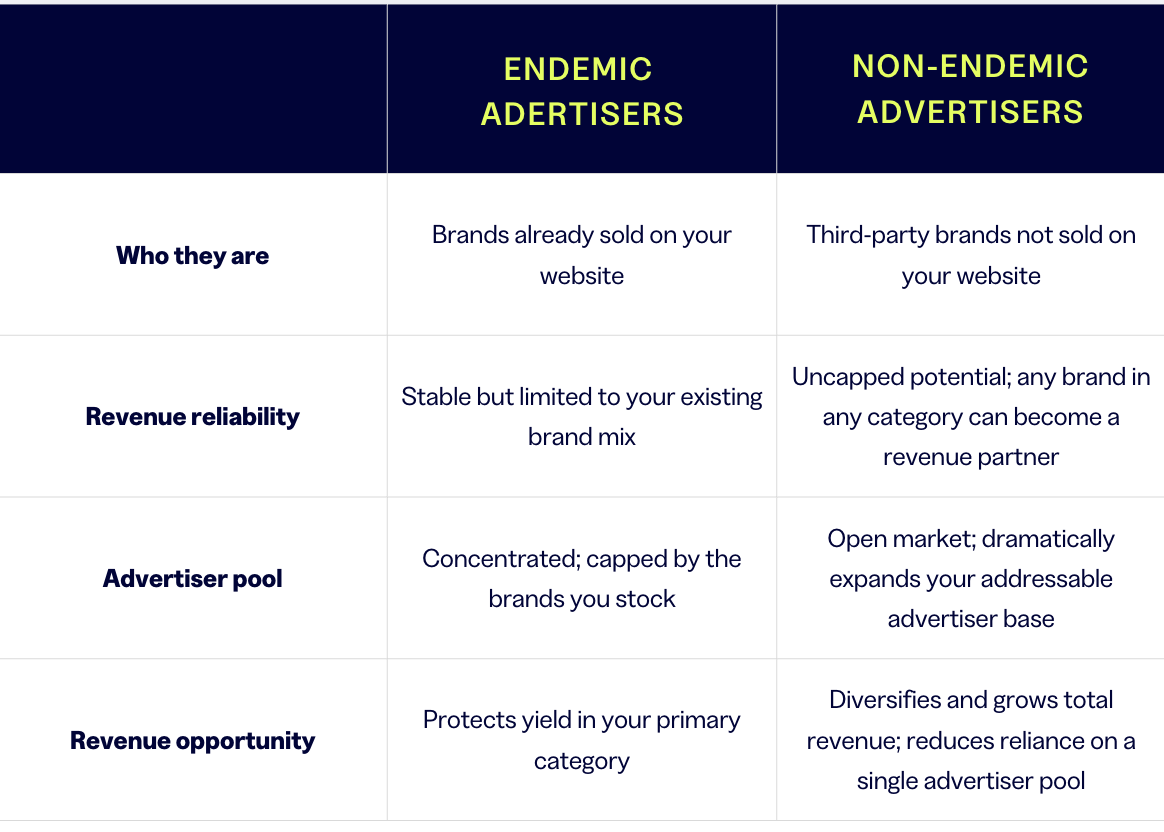
So far, much of that growth has come from endemic advertising, where brands pay to appear on retailer sites that already sell their products. This model is useful and measurable, but it does not capture the full scope.
Non-endemic advertising is where the next layer of value sits. By showing relevant offers from advertisers outside their offering, retailers can monetise post-purchase moments that would otherwise go unused. Because the customer is already engaged, these placements can create extra value without relying on discounts or interruptive ads.
For advertisers, this means access to shoppers at a point of real intent. For retailers, non-endemic advertising creates a new revenue stream from existing traffic. For customers, non-endemic can add useful value at the end of the buying journey.
This article explains the difference between endemic and non-endemic advertising, why non-endemic retail media is gaining traction, and how retailers can monetise post purchase moments.
What is endemic advertising?
Endemic advertising happens when a brand pays to promote a product that the retailer or platform already sells. The advertiser and the retailer operate in the same commercial environment, and the goal is to drive direct sales of products that are part of the retailer's existing catalogue.
A beauty retailer running a sponsored placement for a skincare brand it stocks is an example of endemic advertising. An electronics retailer promoting a sponsored laptop it sells is endemic advertising. Amazon's sponsored product listings are the most familiar example: the brand pays to appear at the top of search results, and Amazon also stocks the product.
For retailer hosts: Endemic advertising lets retailers improve the visibility of products already in their catalogue, support category performance, and grow retail media revenue from supplier-funded campaigns. The most common placements include search results, category pages, product detail pages, basket recommendations, and checkout placements. Retailers measure success through direct sales of their own inventory.
For advertisers: Endemic advertising helps brands win more visibility in environments where their products are already sold. It captures shoppers who are actively browsing the relevant category, and the path from impression to purchase is short. Performance is measured using sales-linked metrics such as Return on Ad Spend, Advertising Cost of Sale, and conversion rate.
What is non-endemic advertising?
Non-endemic advertising happens when a retailer promotes an offer from a brand it does not sell. The advertiser and the retailer operate in different commercial categories, but the retailer's audience and customer moments still hold genuine commercial value for the advertiser.
A fashion retailer showing a travel offer after checkout is non-endemic advertising. A homeware retailer showing an insurance offer after purchase is non-endemic advertising. A pet retailer showing a streaming subscription, a meal kit promotion, or a financial services offer is non-endemic advertising. The retailer is not selling these products, but it is hosting the placement and earning advertiser-funded revenue from doing so.
For retailer hosts: Non-endemic advertising lets retailers monetise their audience beyond the products they sell. It creates a new revenue stream without adding inventory, without changing pricing, and without discounting. Common placements for non-endemic retail media include order confirmation pages, thank-you pages, post-purchase email journeys, and loyalty hubs. Retailers stay in control by approving every advertiser through a whitelist process.
For advertisers: Non-endemic advertising gives eCommerce brands access to high-intent shoppers on trusted retailer sites, even when their product is not stocked there. It works particularly well for trials, subscriptions, memberships, services, and offers that benefit from a moment of customer attention. Non-endemic advertising also reduces the dependency on paid social and paid search, where competition is high and audiences are increasingly fatigued.
Turning post-purchase touchpoints into revenue with Gift After Purchase
Gift After Purchase is one of the clearest examples of non-endemic advertising in action. The offer is funded by an external advertiser brand, the retailer hosts the placement, and the customer receives added value after they have completed their purchase.
The non-endemic advertising format appears in post-purchase moments the retailer already owns, such as the thank-you page, order confirmation page or post-purchase email journey. It can be delivered as an overlay, embed or email placement, depending on the customer experience.
These placements do not interfere with checkout. The purchase is already complete before the customer sees the offer, which means the retailer can create additional value without adding friction to the path to conversion.
For retailer hosts: Gift After Purchase lets retailers monetise the post-purchase journey, generate incremental revenue after the sale, and add genuine value to the customer experience without reducing margin. Because it sits after checkout, there is no risk of distracting shoppers before they complete their order. It also improves the final impression of the customer journey, which supports retention and repeat purchase.
For advertisers: Gift After Purchase gives advertisers access to verified recent buyers in a moment of attention and trust. The retailer context improves relevance, while the post-purchase placement gives the offer a stronger chance of being noticed and acted on.
How to choose the right non-endemic partners
The strength of a non-endemic programme is not measured by how many advertisers it includes. It is measured by how relevant those advertisers are to the retailer's audience and how positively customers respond to the offers they see. Showing any brand that will pay leads to weak performance and risks damaging the customer experience. Curation matters.
For retailer hosts: Retailers should evaluate non-endemic advertisers on audience fit, category complementarity, brand safety, customer value, offer quality, and commercial performance. They should also confirm that the advertiser does not conflict with products already sold by the retailer. Critically, the retailer should be able to approve or reject every advertiser before any offer goes live, with full whitelisting control built into the programme.
For advertisers: Advertisers should evaluate retailer hosts on audience relevance, purchase context, brand alignment, customer intent, placement quality, and the strength of the measurement and optimisation tooling available. The ability to test and learn across different segments is essential, because what works on one retailer audience will not always translate cleanly to another.
How Tyviso supports non-endemic Gift After Purchase
Tyviso’s platform manages partner discovery, advertiser approval, placement delivery, integration, and ongoing optimisation. To date, Tyviso has delivered over 700 million gifts and rewards and launched over 1,000 brand partnerships across categories including telecoms, consumer electronics, fashion, and home appliances.
For retailer hosts: Tyviso supports retailer hosts with partner discovery and advertiser matching, manual whitelisting, post-purchase placement delivery, integration support, performance tracking, and campaign optimisation. The format creates monetisation without discounting and without adding stock, and it works on both web and in-app environments.
For advertisers: Tyviso gives advertisers access to relevant retailer audiences, curated post-purchase placements, offer testing and optimisation tools, and performance-led acquisition campaigns. Every placement sits within a vetted, brand-safe environment, which provides a credible alternative to the volatility of paid social and paid search.
On trust and compliance, Tyviso operates a whitelist-only network with no open exchange. Retailers approve every advertiser partner before campaigns go live. By default, Tyviso does not capture personal customer data, which simplifies procurement and data protection sign-off. The platform is GDPR compliant, ISO 27001 certified, and operates within ASA guidelines.
Common questions about non-endemic advertising
How should retailers decide which non-endemic advertisers to allow?
The decision should be based on customer relevance, brand safety, category rules, commercial return and whether the offer adds value to the purchase journey. The strongest programmes use whitelisting, exclusions and approval workflows rather than open advertiser access.
Does non-endemic advertising compete with the retailer’s own products?
It should not. A well-run programme excludes direct competitors and focuses on complementary or adjacent offers that add value without replacing demand for the retailer’s own products.
Why is Gift After Purchase suited to non-endemic advertising?
Gift After Purchase works because it places the advertiser's offer after the sale has been secured. This means the retailer can generate incremental media value without changing product pricing, disrupting checkout or training customers to wait for discounts.
What do advertisers get that they cannot easily get from paid social or display?
Advertisers get access to high-intent retail audiences in a trusted, context-rich environment. Instead of competing in crowded feeds or open-web placements, they appear at a moment where the customer is already engaged and more likely to act.
What metrics should retailers use to judge success?
Retailers should look beyond just clicks and incremental revenue. Offer engagement rate, redemption rate, impact on customer experience andrepeat purchase rate are other important metrics to track.
What separates a good non-endemic programme from a weak one?
A good programme is curated, controlled and measured. A weak one feels like generic ad inventory. Relevance, timing, brand approval, placement testing and commercial transparency are what make the difference.
Transcript
As Head of Affiliates at award-winning Performance Marketing agency Genie Goals, Rachel Said scales brands through transparent partnerships. She is a vocal advocate for the unique role affiliates play in cross-channel plans to drive high-impact growth and incremental results.