
As Head of Affiliates at award-winning Performance Marketing agency Genie Goals, Rachel Said scales brands through transparent partnerships. She is a vocal advocate for the unique role affiliates play in cross-channel plans to drive high-impact growth and incremental results.

A gift with purchase is a promotional mechanic in which a customer receives an item or reward upon reaching a qualifying threshold, such as a minimum basket value, a specific product category, or a checkout completion trigger. It is one of the most versatile tools available to enterprise e-commerce teams, with applications across conversion rate optimisation, average order value growth, basket abandonment reduction, and brand partnership development.
This guide brings together everything enterprise retailers need to know about gift with purchase strategy. It explores what gift with purchase is, why it works, and where it fits within the Commerce Journey. It also looks at its role in increasing average order value and conversion, how brand partnerships can help fund the programme at scale, and the key implementation considerations for enterprise platforms.
What is a gift with purchase in e-commerce?
A gift with purchase is a value-add promotional mechanic. It differs from a discount in a structurally important way: rather than reducing the price of an existing product, it introduces an additional item or reward at or above a defined threshold. The customer pays full price for the product they intended to buy and receives something extra.
That distinction matters for margin, brand perception, and customer behaviour throughout the Commerce Journey. At its core, gift with purchase adds value to the transaction rather than taking value away through discounting, allowing brands to protect margins while strengthening the overall customer experience.
How does gift with purchase work?
A gift with purchase strategy works because it activates well-established behavioural principles.
1) Reciprocity: When customers feel they are receiving a gift, they are more inclined to complete a transaction.
2) Perceived value: The presence of a free item increases the overall value of the purchase, making the total spend feel more worthwhile.
3) Urgency: When a gift is only available before a deadline or above a certain spend threshold, customers feel more motivated to act quickly.
4) Relevance: This is perhaps the most important factor of all. A gift that is logically connected to the product being purchased strengthens all of the effects above. A customer buying a washing machine who receives a premium laundry product as a gift experiences a useful and coherent addition to their purchase. A customer who receives something unrelated is far less likely to feel the same impact. Relevance is the principle that separates high-performing gift with purchase programmes from average ones.
How does gift with purchase improve average order value?
Average order value (AOV) is the mean revenue generated per completed transaction over a defined period. It is calculated by dividing total revenue by the number of orders and is one of the most direct levers available to e-commerce teams looking to grow revenue without increasing acquisition spend.
The most widely used gift with purchase structure for AOV growth is the spend-threshold model. A gift becomes available when a customer's basket exceeds a defined value, for example, a free item when spending above a set amount. This creates a natural incentive for customers whose baskets are close to the threshold to add additional items to qualify.
The threshold should be set above the current average basket value for the relevant customer segment, so that reaching it requires some additional spend, but is close enough to be achievable without significant effort. Setting the threshold too high reduces participation; setting it too low yields minimal AOV improvement.
Beyond the threshold mechanic, a gift with purchase also lifts AOV through the perceived value effect described above. Customers who feel they are receiving a better deal are more willing to complete a higher-value purchase at full price. This psychological dynamic is distinct from the threshold incentive and operates even when no specific spend target has been set.
How should brands measure optimisation performance?
While most promotional tactics move a single metric, gift with purchase can improve basket completion rate, average order value, revenue per session, and customer satisfaction within the same programme. The table below summarises how each metric is affected, illustrated by results from Tyviso's enterprise case studies.
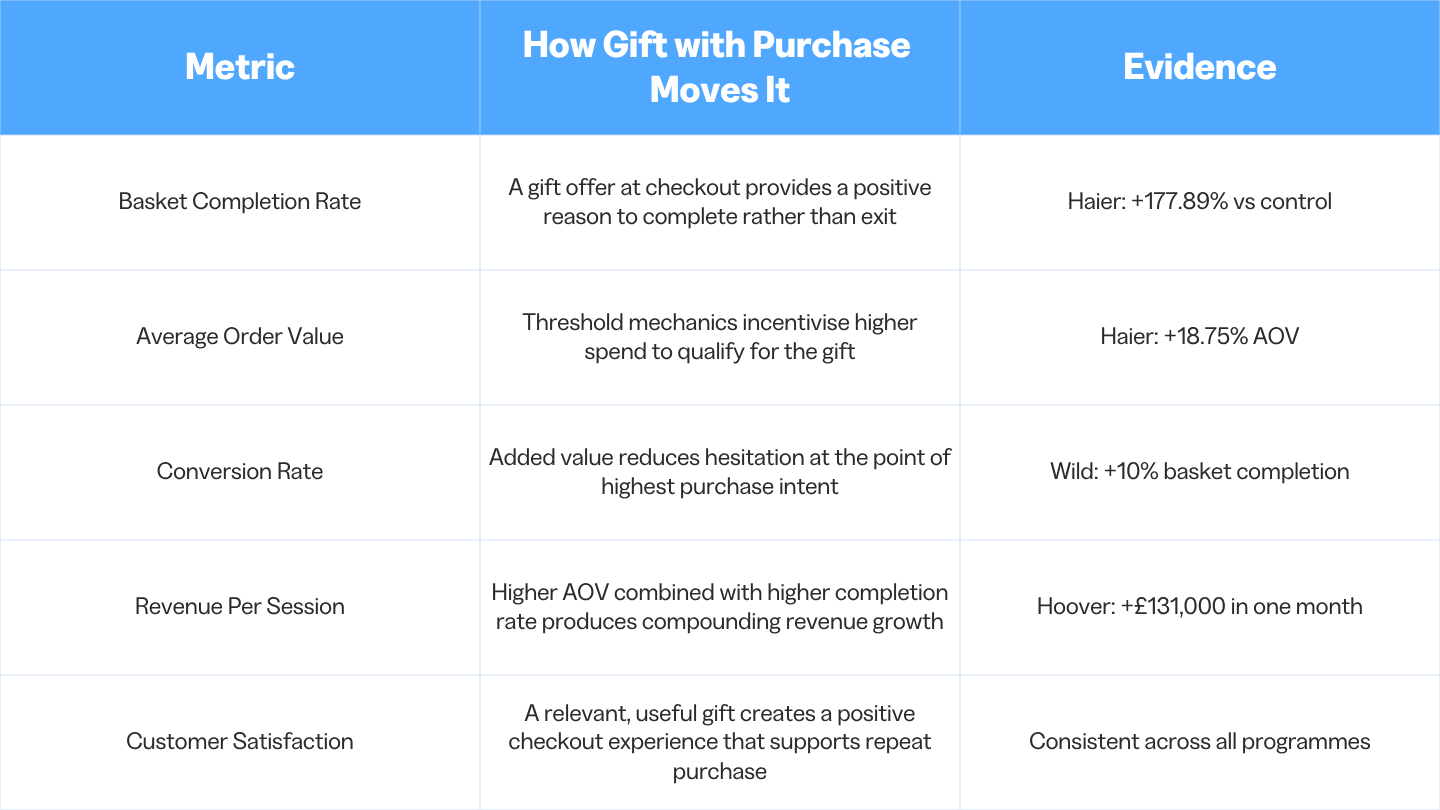
This multi-metric profile is a significant advantage for enterprise teams required to demonstrate ROI across multiple KPIs simultaneously. A single, well-executed gift with purchase programme can generate evidence across conversion, revenue, and experience metrics simultaneously.
Hoover's contextual matching approach is a particularly clear illustration of this principle. By serving gift offers based on the specific contents of each customer's basket in real time, rather than applying a single generic offer to all customers, Hoover achieved a conversion rate for gift-engaged customers that was 4.3 times higher than for customers who saw a standard checkout experience.
How does gift with purchase fit into the Commerce Journey?
The Commerce Journey typically comprises five stages: awareness, consideration, decision, purchase, and post-purchase. Gift with purchase is most effective within the decision and purchase stages, specifically at the basket and checkout pages, for reasons grounded in purchase psychology.
By the time a customer reaches the basket stage, they have already identified a product that meets their need and taken a deliberate action to add it to their cart. Their intent to purchase is established. At this point, the question is completion, and any additional value introduced at this moment is received in a favourable context.
Introducing a gift with purchase offer earlier in the journey, at the awareness or consideration stage, produces weaker results because the customer's intent is less firm and the offer is perceived as advertising rather than a reward. The timing of the offer is as important as the offer itself.
What behavioural triggers does this strategy activate at the decision stage?
Several specific behavioural triggers become active at the decision stage of the Commerce Journey that gift with purchase is well positioned to engage:
- Loss aversion: A customer who is aware of an available gift but has not yet qualified for it is motivated to complete their purchase before the opportunity is removed
- Confirmation bias: A gift that aligns with the customer's purchase intent confirms that their decision is well-founded, reinforcing the commitment to buy
- Completion tendency: Once a customer has reached a defined threshold, the psychological pull toward completing the qualifying action increases
Each of these triggers is more potent at the basket and checkout stage than at any earlier point in the Commerce Journey, which is why placement at these specific touchpoints consistently outperforms earlier-funnel implementations.
How can brands recover more abandoned baskets?
Basket abandonment is the phenomenon by which customers who have added items to a cart exit the site before completing the purchase. It represents a significant and measurable revenue gap for every e-commerce operation. Understanding the causes of abandonment is the first step toward addressing them.
What causes basket abandonment and how does gift with purchase address it?
Basket abandonment research consistently points to a few common causes, including:
- Price sensitivity
- Low perceived value
- Lack of urgency
- Distraction during checkout
Gift with purchase is especially effective at tackling low perceived value and lack of urgency, making it a strong strategy for reducing basket abandonment.
When a customer perceives the checkout transaction as offering fair value, their motivation to complete is stronger. A gift offer at the basket stage increases perceived value without altering the product's price. The customer receives more for the same outlay, and their sense of the transaction's fairness improves accordingly.
A conditional gift offer, available only for a limited time or only upon completing the purchase, also introduces a time-sensitive motivation. Customers who are undecided have a specific, concrete reason to act rather than defer.
Importantly, this approach addresses price sensitivity indirectly. Customers who are hesitant about a product's price often respond more positively to added value than to a reduced price. The commercial outcome is equivalent in terms of conversion, but the margin outcome is substantially different as a gift with purchase preserves the full price point.
How to increase e-commerce conversion rates with gift with purchase
Conversion rate optimisation (CRO) is the practice of systematically improving the proportion of visitors who complete a desired action. In e-commerce, the primary conversion event is purchase completion, and CRO programmes typically involve testing changes to page layout, copy, flow, and promotional mechanics to identify configurations that produce higher completion rates.
How does gift with purchase complement an existing CRO programme?
Most CRO interventions at the checkout stage focus on reducing friction: simplifying form fields, offering multiple payment methods, and improving page load speed. These are valuable optimisations, but they address the absence of obstacles rather than the presence of positive motivation. Gift with purchase adds the latter.
A customer who has encountered a smooth checkout process is still a customer who may or may not complete a purchase. A customer who encounters a smooth checkout process and is also offered a relevant, valuable gift has an additional, positive reason to follow through. These two approaches are complementary rather than competing.
How should teams A/B test gift with purchase as a conversion intervention?
Rigorous A/B testing is a prerequisite for attributing improvements in conversion to any specific intervention. Gift with purchase is well-suited to controlled testing because the offer can be shown to one cohort and withheld from another, with basket completion rate tracked across both. The results are directly attributable to the presence or absence of the offer.
Testing also allows teams to identify the configuration with the highest performance before committing to a full deployment. The specific gift, its placement on the page, the threshold at which it triggers, and the partner brand associated with it all affect outcomes. A structured test programme identifies the highest-performing combination rather than relying on assumptions.
How does gift with purchase support customer lifetime value?
The impact of gift with purchase extends beyond the immediate transaction. A positive checkout experience, one in which a customer receives an unexpected and relevant addition to their order, creates a measurable improvement in post-purchase satisfaction. Satisfied customers have higher rates of repeat purchase, higher lifetime spend, and a greater likelihood of recommending the brand to others.
For enterprise retailers managing large customer bases, even a fractional improvement in repeat purchase rate has a substantial revenue impact at scale. This makes gift with purchase a contributor to customer lifetime value (CLV) as well as a conversion tool, and justifies its evaluation within both a CRO and a retention strategy context.
Gift with purchase also creates product discovery pathways. When a customer encounters a new brand or product through a gift, it expands their awareness of categories adjacent to their original purchase. This exposure can generate future purchases that originate from the gifting experience rather than from any separate marketing activity.
Gift with purchase vs discounting
Discount-based promotions and gift with purchase are both used to influence purchase behaviour at checkout, but they operate through different mechanisms and produce different long-term outcomes. Understanding the structural differences between them is important for retailers designing a sustainable promotional strategy.
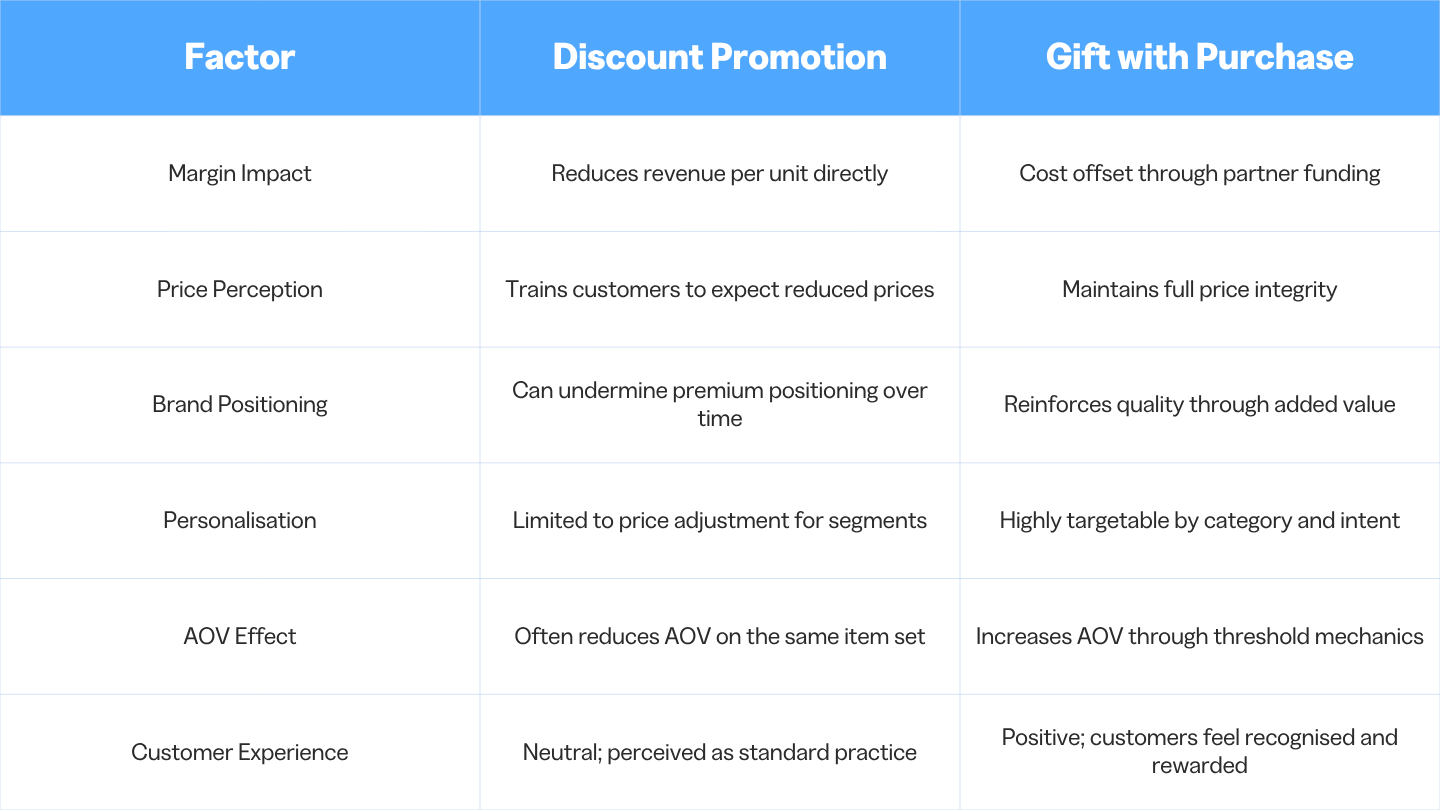
The table above reflects the general pattern across retail categories. The appropriate choice for any given programme depends on the retailer's margin structure, brand positioning, and customer base characteristics. For retailers where brand equity and price integrity are strategic priorities, gift with purchase typically represents the stronger long-term option.
Brand partnerships and retail media: making gift with purchase self-funding
A significant structural advantage of gift with purchase at enterprise scale is the potential to fund the programme through brand partnerships. Rather than absorbing the cost of gifts from internal budgets, retailers can establish relationships with complementary brands that offer gifts in exchange for access to the retailer's purchase-stage audience.
This model transforms gift with purchase from a cost to a revenue-generating commercial arrangement. The partner brand gains a channel for product trial and brand exposure at the point of highest purchase intent. The retailer gains a funded gift programme that improves conversion metrics at no direct cost.
How does a partner-funded gift with purchase programme connect to retail media?
Retail media networks have grown substantially in recent years because they offer brand partners something that traditional digital advertising struggles to provide: access to audiences at the moment of active purchase intent, in a contextually relevant setting.
A checkout-stage gift with purchase placement is a high-value retail media position. The customer is in the process of completing a purchase, their attention is focused, and the offer appears in the context of a transaction they have chosen to make. Click-through and engagement rates at this stage consistently outperform equivalent placements earlier in the Commerce Journey.
How do enterprise e-commerce teams set up gift with purchase?
For enterprise retailers moving from evaluation to implementation, the technical and operational questions become central. Platforms such as Tyviso are designed to help enterprise teams launch partner-funded gift with purchase programmes through lightweight integrations, clear offer logic, and scalable campaign management across the Commerce Journey.
How to build a successful gift with purchase programme
A successful gift with purchase programme is built on more than a good promotional idea. Getting it right at the enterprise level requires the right technical foundations, relevant partner offers, and a structured approach to testing and improvement. Here is what each element involves.
Technical integration
A well-designed gift with purchase system integrates into existing checkout infrastructure with minimal development resources. The integration should be lightweight, platform-compatible, and designed to avoid any interference with the existing checkout flow. Testing the integration in a staging environment before deployment allows teams to confirm behaviour across all device types and basket configurations.
Partner selection and offer relevance
The partner selection process should begin with the customer's purchase context. For each major product category, the question is: what would a customer purchasing this product find genuinely useful or interesting to add to their order? Complementary product categories, subscription services relevant to the product's use case, and lifestyle brands with strong alignment to the retailer's customer base all represent strong partner options.
Test design and measurement
A gift with purchase programme launched without a structured test framework makes attribution of results uncertain. Defining control and test cohorts before launch, setting minimum sample sizes to ensure statistical significance, and identifying the primary evaluation metric (typically basket completion rate) in advance are prerequisites for producing reliable data.
Iteration and scaling
The initial test configuration is rarely the highest-performing one. Sustained improvement comes from iterating on the gift offer, threshold, placement, and partner combination based on test data. Teams that approach gift with purchase as an ongoing optimisation programme, rather than a one-time deployment, consistently achieve stronger long-term results.
How Tyviso supports the Commerce Journey with gift with purchase
For enterprise retailers, the value of gift with purchase depends on more than the promotional idea itself. It depends on where the offer appears in the Commerce Journey, how relevant it is to the purchase context, and how easily it can be implemented at scale. Platforms such as Tyviso help retailers activate partner-funded gift with purchase campaigns at key decision and purchase-stage moments, where added value can have the greatest effect on conversion, basket value, and customer experience.
By combining lightweight integration with relevant brand partnerships, Tyviso helps enterprise teams turn gift with purchase into a scalable performance lever across the Commerce Journey. That means protecting margin, improving checkout outcomes, and creating a more valuable experience for customers without relying on discount-led growth.
FAQs about gift with purchase
What is a gift with purchase in e-commerce?
A gift with purchase is a promotional strategy where customers receive an extra item or reward when they meet a qualifying condition, such as reaching a minimum basket value or completing a purchase.
How does gift with purchase increase average order value?
It encourages customers to spend more in order to qualify for the gift, especially when the threshold is set just above their expected basket value.
Does gift with purchase help reduce basket abandonment?
Yes. It can increase perceived value and create urgency at checkout, which gives customers a stronger reason to complete the purchase.
Is gift with purchase better than discounting?
For many retailers, gift with purchase is a stronger long-term strategy because it adds value without reducing the product price, which helps protect margins and brand perception.
Can gift with purchase be funded by brand partnerships?
Yes. Enterprise retailers can work with partner brands to provide relevant gifts, turning the programme into a more scalable and cost-efficient growth strategy.
How do enterprise retailers implement gift with purchase at scale?
They typically use lightweight integration platforms, define clear offer logic, test performance through controlled experiments, and optimise the programme over time.
Transcript
As Head of Affiliates at award-winning Performance Marketing agency Genie Goals, Rachel Said scales brands through transparent partnerships. She is a vocal advocate for the unique role affiliates play in cross-channel plans to drive high-impact growth and incremental results.