

As Head of Affiliates at award-winning Performance Marketing agency Genie Goals, Rachel Said scales brands through transparent partnerships. She is a vocal advocate for the unique role affiliates play in cross-channel plans to drive high-impact growth and incremental results.

Post-purchase monetisation can either strengthen your brand or undermine it. When a thank you page shows a generic offer from an unfamiliar brand in a design that feels out of place, the experience stops feeling seamless. Customers notice that shift immediately, and the trust built throughout the purchase journey begins to weaken.
White-label retail media creates a better outcome. Instead of interrupting the experience, it extends it. The offer looks native to the site, the design matches the retailer’s brand, and the partner feels relevant to the customer. That makes the placement feel less like advertising and more like a valuable part of the journey.
This article explains what white-label retail media is, how it differs from open exchange retail media, and why it has become a smarter post-purchase monetisation strategy for eCommerce brands. It also explores the role of advertiser curation, the link between familiarity and redemption, and how brands can turn the thank you page into a revenue channel without compromising customer experience.
What is white-label retail media?
White-label retail media means that every post-purchase placement is designed and delivered to match the look, feel, and tone of the retailer's brand. There is no visible third-party infrastructure. There is no generic offer unit. The customer sees a seamless continuation of the experience they have had since they first landed on your site.
It is the opposite of open exchange retail media, where placements are served programmatically and the advertiser has little or no control over where their ad appears, and the host retailer has little or no control over what appears on their pages.

Why brand perception drives commercial performance
Brand perception has a direct revenue impact. Customers are more likely to return, recommend, and spend again when every part of the Commerce Journey feels consistent, including the experience after checkout.
That is why the thank you page matters in this journey. It is the final impression a retailer leaves after the sale, and it plays a crucial role in shaping long-term customer value. A seamless post-purchase experience reinforces trust, while a well-presented offer can add value without weakening the brand relationship.
White-label retail media helps brands achieve that balance. It keeps post-purchase placements aligned with the retailer’s identity, so the experience feels curated, relevant, and commercially intelligent. The result is stronger engagement, better brand perception, and a more valuable customer relationship over time.
The familiarity effect in post-purchase monetisation
There is a well-established principle in consumer psychology that people are more likely to engage with things that feel familiar. When a post-purchase offer is presented in a format that matches the brand they have just bought from, it carries an implied endorsement. The customer's relationship with the retailer transfers, to some extent, to the offer itself.
This effect is proven in redemption data. Offers that are presented in brand-matched, white-label formats consistently outperform the same offers served in generic or mismatched formats.
An offer that looks like it belongs on your page feels like it was chosen for your customers. An offer that looks like an ad feels like it was chosen for someone else's revenue target. Customers can tell the difference, even if they cannot articulate it.
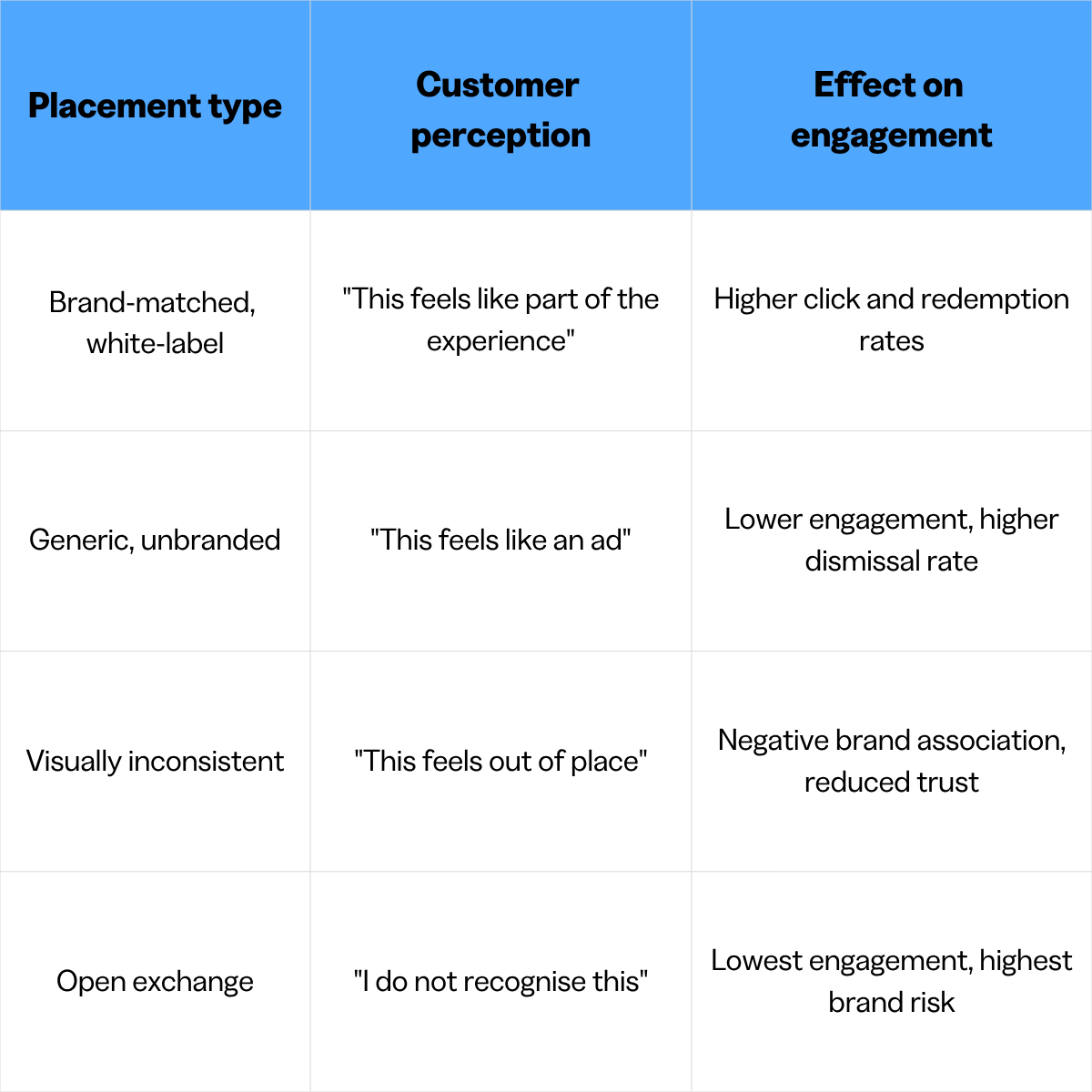
Why advertiser curation matters as much as design
White-label design is only one part of an effective post-purchase monetisation strategy, because the brands that appear in those placements matter just as much as the design itself. A well-designed offer unit can still underperform if the partner brand feels irrelevant to the customer, while a partner brand that clashes with your values or positioning can create a brand safety issue regardless of how polished the placement looks.
For that reason, manual curation of advertisers is essential to any serious post-purchase monetisation strategy. Retailers need control over which brands appear, where they appear, and which customer segments they are shown to. That level of control is what makes the experience feel curated and relevant, which is ultimately what drives stronger performance.
The role of Gift After Purchase in white-label retail media
Gift After Purchase is Tyviso's post-purchase monetisation solution. It places curated, brand-safe offers from partner brands on the thank you page, presented in a white-label format that matches the retailer's design and tone.
Every element of the placement is configurable. This includes the imagery, copy style, layout, and colour palette. The customer sees an offer that feels like it was built by the retailer for them, not served by a third party for someone else's benefit.
The more native the placement feels, the more likely the customer is to engage. The more they engage, the more incremental revenue the retailer generates. The more positive the experience, the stronger the signal to return.
.png)
What the data says
The commercial case for white-label post-purchase monetisation is well supported by results from Tyviso's merchant base.
Across the platform, Gift After Purchase delivers an average of £110K per one million transactions in new revenue. That is revenue generated from the thank you page alone, without discounting, without additional acquisition spend, and without any compromise to the core brand experience.
These outcomes are not the result of serving more offers or more aggressive placements. They are the result of serving the right offers, in the right format, to customers who felt like the experience was built for them.
Frequently asked questions about white-label retail media
Why does white-label design improve redemption rates?
Because familiarity reduces friction. When an offer looks and feels like it belongs on the page, customers are more likely to trust it and act on it. Design consistency carries an implied endorsement from the retailer, and that endorsement transfers to the offer.
What is the difference between white-label retail media and native advertising?
Native advertising matches the format of editorial content. White-label retail media matches the brand identity of the retailer. The distinction matters because the goal is not to mimic content. It is to ensure the commercial offer feels like a seamless part of the brand experience rather than an interruption to it.
How does manual curation of partner brands differ from programmatic selection?
Programmatic selection uses algorithms to match advertisers to placements based on bid price and audience signals. Manual curation means a human reviews and approves every brand before it can appear. The initial selection is guided by tools such as GiftRank, which use algorithmic analysis to identify the partner brands most likely to perform for a retailer’s audience. The result is a partner set that is genuinely appropriate for the retailer's audience and brand positioning, not just algorithmically adjacent.
Does white-label retail media require significant technical resources to implement?
Not with Tyviso. Gift After Purchase integrates via tag, API, or your affiliate network. The white-label configuration is managed through the platform without heavy development lift. Retailers go live quickly and without engineering dependency.
The thank you page should feel like yours
The moment after purchase is the moment to reinforce your own brand identity across the customer experience. It is an opportunity to keep the customer inside the journey you have built and to present an offer that feels considered, relevant, and consistent with the brand they have just chosen.
White-label retail media makes that possible at scale, and Gift After Purchase is how Tyviso delivers it.
For eCommerce brands looking to generate measurable incremental revenue while strengthening brand experience, Tyviso offers a smarter approach to post-purchase monetisation.
Transcript
As Head of Affiliates at award-winning Performance Marketing agency Genie Goals, Rachel Said scales brands through transparent partnerships. She is a vocal advocate for the unique role affiliates play in cross-channel plans to drive high-impact growth and incremental results.